Guide
Watch Movements Explained: Mechanical, Automatic & Quartz Watches
The movement is the engine that powers a watch. Here's a plain-English guide to mechanical, automatic and quartz movements — and the proven Seiko calibres we use at Rose & Rotors.
Quick answer: Watch movements come in four main types: automatic (self-winding mechanical), manual (hand-wound mechanical), quartz (battery and crystal) and meca-quartz (quartz timekeeping with a mechanical chronograph module). Rose & Rotors uses the Seiko NH35 and NH34 automatics and the VK63 meca-quartz.
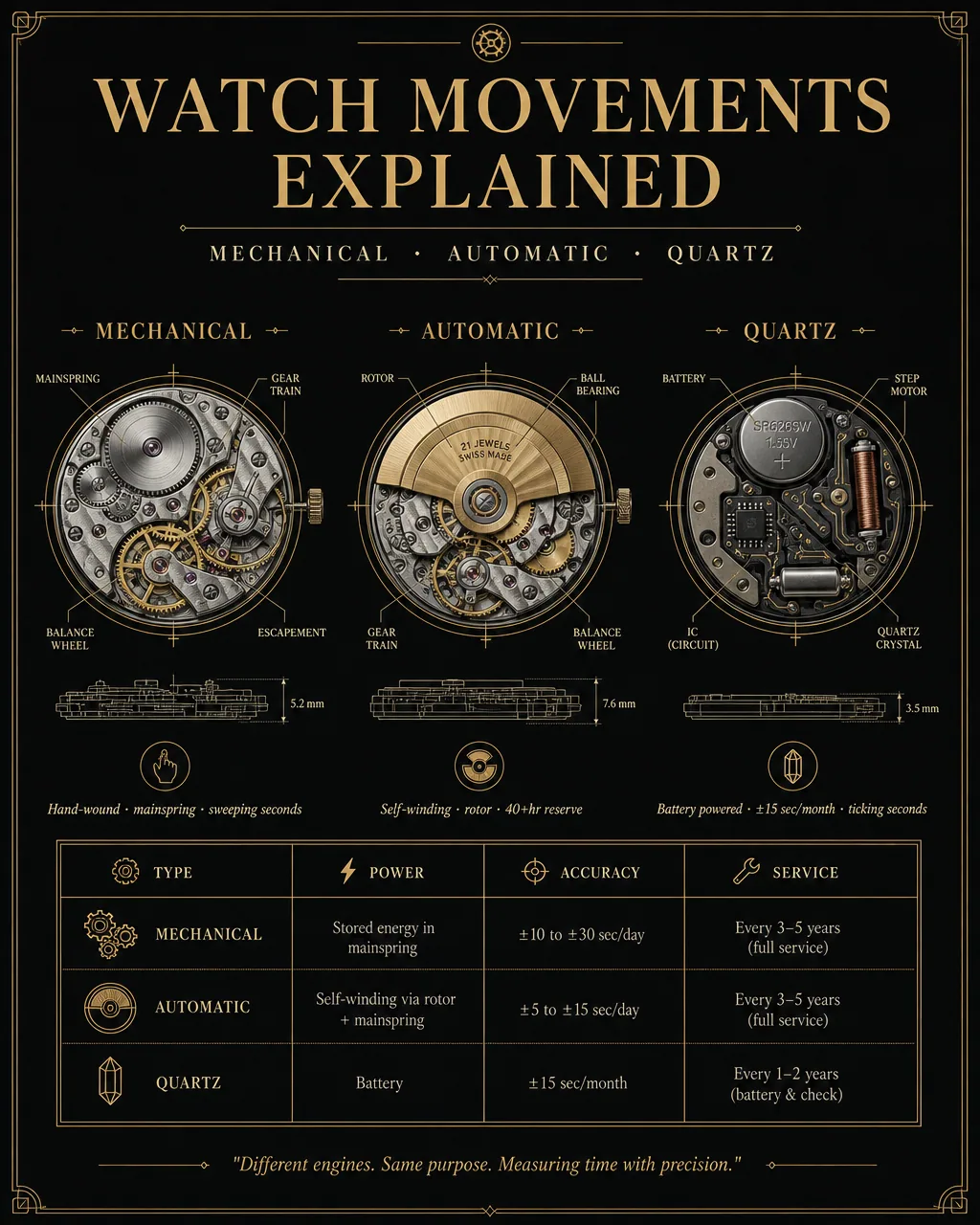
The Heart of Every Watch
The movement is the engine that powers a watch. Hidden beneath the dial, it controls every tick of the second hand and keeps accurate time day after day.
Whether you're buying your first watch or building a collection, understanding watch movements will help you choose the right watch for your lifestyle.
At Rose & Rotors, we carefully select proven Seiko movements known for their reliability, durability and serviceability. Before exploring our specific movements, it's worth understanding the three main movement types used throughout the watch industry.
Mechanical Movements
Mechanical watches are the oldest form of watchmaking and remain highly respected among enthusiasts today.
A mechanical movement is powered entirely by a mainspring. As the spring unwinds, it transfers energy through a series of gears and an escapement, regulating the movement of the hands.
Advantages
- Traditional craftsmanship
- No battery required
- Smooth sweeping seconds hand
- Highly collectable
- Can last for generations when serviced
Disadvantages
- Requires manual winding
- Less accurate than quartz
- More expensive to manufacture and service
Mechanical watches are often appreciated for their engineering rather than their accuracy. Many collectors enjoy the ritual of winding their watch each day and the connection it creates with the movement inside.
Automatic Movements
Automatic watches are a type of mechanical watch that winds themselves while being worn.
Inside the watch is a weighted rotor that spins as your wrist moves throughout the day. This rotor continuously winds the mainspring, keeping the watch running without manual winding.
Most modern enthusiast watches use automatic movements due to their convenience and mechanical appeal.
Advantages
- No battery required
- Self-winding
- Traditional mechanical engineering
- Long service life
- Smooth sweeping seconds hand
Disadvantages
- Less accurate than quartz
- Can stop if not worn regularly
- Requires servicing over time
Automatic watches represent the perfect balance between traditional watchmaking and everyday practicality.
Quartz Movements
Quartz watches are powered by a battery rather than a mainspring.
A small quartz crystal vibrates at a precise frequency when electricity passes through it. These vibrations are used to regulate timekeeping with exceptional accuracy.
Since their introduction, quartz movements have become the most common watch movement in the world.
Advantages
- Extremely accurate
- Low maintenance
- Affordable
- Reliable
- Long battery life
Disadvantages
- Requires battery replacement
- Less mechanical character
- Often considered less desirable by enthusiasts
Quartz technology transformed the watch industry and continues to be the most practical solution for everyday timekeeping.
Seiko and the Quartz Revolution
Few companies have shaped modern watchmaking more than Seiko.
Founded in Japan in 1881 by Kintaro Hattori, Seiko built its reputation on innovation and engineering excellence.
In 1969, Seiko introduced the world's first commercially available quartz wristwatch, the Quartz Astron. This groundbreaking release revolutionised the watch industry by providing unprecedented accuracy at a fraction of the cost of traditional Swiss mechanical watches.
The impact was so significant that the period became known as the "Quartz Revolution" and permanently changed the watch industry.
Today, Seiko remains one of the world's most respected movement manufacturers, producing millions of movements used by both Seiko and independent watch brands around the globe.
Why Rose & Rotors Uses Seiko Movements
At Rose & Rotors, we prioritise reliability, serviceability and long-term ownership.
Seiko movements offer:
- Proven reliability
- Global parts availability
- Easy servicing
- Excellent durability
- Strong enthusiast reputation
Rather than chasing marketing hype, we focus on movements that have earned their reputation through years of real-world performance.
The Seiko NH35
The NH35 is one of the most popular automatic watch movements ever produced.
Known for its reliability and durability, the NH35 powers countless enthusiast watches around the world.
Key features include:
- Automatic winding
- Manual winding capability
- Hacking seconds
- Date function
- Approximately 41-hour power reserve
- 21,600 vibrations per hour
The NH35 has become the benchmark movement for quality automatic watches and is trusted by watchmakers globally.
Complete Guide to the Seiko NH35 Movement →
The Seiko NH34
The NH34 builds upon the proven NH35 platform by adding a GMT complication.
A GMT watch allows the wearer to track a second time zone using an additional 24-hour hand.
Key features include:
- Automatic winding
- GMT functionality
- Manual winding
- Hacking seconds
- Date function
- Approximately 41-hour power reserve
For travellers and GMT enthusiasts, the NH34 offers exceptional value and reliability.
Complete Guide to the Seiko NH34 GMT Movement →
The Seiko NH05
The NH05 is a compact automatic movement designed for smaller watch cases.
Despite its reduced size, it retains many of the qualities that make Seiko automatic movements so popular.
Key features include:
- Automatic winding
- Compact dimensions
- Reliable operation
- Suitable for smaller watches
- Approximately 40-hour power reserve
The NH05 is commonly used in elegant and smaller-format watches where space is limited.
The Seiko VK63
The VK63 is part of Seiko's highly respected Mecha-Quartz family.
Unlike traditional quartz chronographs, the VK63 combines battery-powered accuracy with a mechanical chronograph module.
The result is a chronograph that delivers the satisfying feel and hand movement of a mechanical watch while maintaining quartz reliability.
Key features include:
- Mecha-quartz technology
- Chronograph functionality
- Instant reset action
- Excellent accuracy
- Low maintenance
- Long battery life
The VK63 has become one of the most popular chronograph movements available today.
Complete Guide to the Seiko VK63 Movement →
Which Movement Is Right For You?
Choose a Mechanical Watch If:
- You appreciate traditional watchmaking
- You enjoy winding your watch
- You value craftsmanship over accuracy
Choose an Automatic Watch If:
- You want traditional engineering
- You wear your watch regularly
- You prefer a battery-free experience
Choose a Quartz Watch If:
- You prioritise accuracy
- You want minimal maintenance
- You prefer convenience
Choose a GMT Watch If:
- You travel frequently
- You work across multiple time zones
- You enjoy functional complications
Choose a Chronograph If:
- You enjoy sporty watch designs
- You want stopwatch functionality
- You appreciate mechanical interaction
Explore Rose & Rotors Watches
Every Rose & Rotors watch is selected with reliability, durability and long-term ownership in mind.
Whether you're looking for a dependable NH35 automatic, a GMT-powered NH34, a compact NH05 or a sporty VK63 chronograph, you'll find a movement designed to provide years of dependable service and enjoyment.
Browse our collection to discover the movement that best suits your lifestyle.
Keep exploring
Related watches
Frequently Asked Questions
What is the difference between a mechanical and an automatic watch?
Both are mechanical movements powered by a mainspring rather than a battery. A traditional mechanical (hand-wound) watch must be wound manually via the crown, while an automatic winds itself using a weighted rotor that spins as you move your wrist.
Are quartz watches more accurate than automatic watches?
Yes. A typical quartz movement is accurate to within around ±15 seconds per month, while a well-regulated automatic movement such as the Seiko NH35 is usually accurate to within around ±20 to ±40 seconds per day.
How often should an automatic watch be serviced?
Most automatic watches benefit from a full service every 5 to 7 years. Regular servicing cleans and re-lubricates the movement, replaces worn parts and helps preserve accuracy and long-term reliability.
Do quartz watches need servicing?
Quartz watches require far less maintenance than mechanical watches. The battery typically needs replacing every 2 to 3 years, and a full service is only recommended occasionally to check seals and clean the movement.
Why does Rose & Rotors use Seiko movements?
Seiko movements such as the NH35, NH34, NH05 and VK63 are proven, reliable and easy to service worldwide. They offer excellent long-term ownership value and are trusted by enthusiast microbrands globally.
Which watch movement is best for everyday wear?
For a low-maintenance daily watch, a quartz or Meca-Quartz movement such as the Seiko VK63 is ideal. If you prefer traditional mechanical engineering and wear your watch regularly, an automatic such as the Seiko NH35 is an excellent everyday choice.