Guide
GMT Watches Explained
How a GMT watch tracks a second time zone, the difference between a flyer GMT and an 'office GMT', and how to set the 24-hour hand.
Quick answer: A GMT watch shows a second time zone with an extra 24-hour hand read against a 24-hour bezel or dial scale. The GMT Rose uses the Seiko NH34, a caller (office) GMT: the 24-hour hand is set independently while the main hour hand shows local time.
Shop GMT Watches →How to set and use it
What Is a GMT Watch and How Does It Track Multiple Time Zones?
GMT watches are one of the most useful and popular watch complications available today.
Originally developed for pilots and international travellers, GMT watches allow you to track multiple time zones simultaneously, making them ideal for travel, business, or simply keeping an eye on the time in another part of the world.
But what exactly is a GMT watch, how does it work, and what's the difference between a 'flyer GMT' and an 'office GMT'?
In this guide, we'll explain everything you need to know in plain English.
What Does GMT Mean?
GMT stands for Greenwich Mean Time.
Named after the Royal Observatory in Greenwich, London, GMT was historically used as the world's reference time standard.
Although UTC (Coordinated Universal Time) is now used internationally, the term 'GMT watch' has remained part of watchmaking terminology.
Today, a GMT watch simply refers to a watch capable of tracking more than one time zone at the same time.
What Is a GMT Watch?
A GMT watch looks similar to a standard watch but includes an additional hand that completes one full rotation every 24 hours instead of every 12 hours.
This extra hand works alongside a 24-hour scale, usually displayed on:
- A dedicated chapter ring
- A fixed bezel
- A rotating 24-hour bezel
The additional hand allows you to track a second time zone without affecting the main hour and minute hands.
How Does a GMT Watch Work?
A standard watch has:
- Hour hand
- Minute hand
- Seconds hand
A GMT watch adds:
- GMT hand (24-hour hand)
The GMT hand moves at half the speed of the regular hour hand.
For example, the hour hand completes one rotation every 12 hours, while the GMT hand completes one rotation every 24 hours.
This allows the GMT hand to indicate whether it's day or night in the second time zone.
Why Is a 24-Hour Scale Important?
Without a 24-hour scale, you wouldn't know whether the second time zone was showing 10am or 10pm.
The GMT hand solves this problem by pointing to a 24-hour scale.
For example, if the GMT hand points to 22, this indicates 10pm rather than 10am.
This makes GMT watches particularly useful when communicating across different countries.
Why Were GMT Watches Invented?
GMT watches became popular during the rise of international air travel in the 1950s.
Pilots needed an easy way to track:
- Local time
- Home time
- Destination time
GMT watches provided a simple mechanical solution.
Today, they remain popular with:
- Frequent travellers
- Airline crew
- International business professionals
- Military personnel
- Watch enthusiasts
What Is a Flyer GMT?
A Flyer GMT is designed primarily for travellers.
On a Flyer GMT watch:
- The local hour hand can be adjusted independently.
- The GMT hand remains fixed on home time.
When you arrive in a new country, you simply jump the local hour hand forward or backward without stopping the movement.
Benefits
- Extremely convenient when travelling.
- Quick local time adjustment.
- Home time remains unchanged.
Examples of Flyer GMT movements include:
- Swiss luxury GMT movements
- Tudor MT5652
- Grand Seiko 9S66
What Is an Office GMT?
An Office GMT is designed primarily for people who stay in one location but regularly communicate across time zones.
On an Office GMT:
- The GMT hand is adjusted independently.
- The local hour hand remains linked to the movement.
This design is generally simpler and more affordable to manufacture.
Benefits
- Easy to track a second time zone.
- More affordable.
- Excellent for everyday use.
Is the NH34 a Flyer GMT or an Office GMT?
The Seiko NH34 is an Office GMT movement.
This means:
- Local time is set normally.
- The GMT hand can be adjusted independently.
For most enthusiasts, this is perfectly adequate and provides excellent functionality at an affordable price.
The NH34 has quickly become one of the most popular GMT movements available today.
Complete Guide to the Seiko NH34 GMT Movement →
How to Read a GMT Watch
Let's assume the main hands show local UK time and the GMT hand points to 17 on the bezel.
The GMT hand is showing 17:00 — or 5pm — in the second time zone.
This allows you to instantly see both times at a glance.
How to Set a GMT Watch
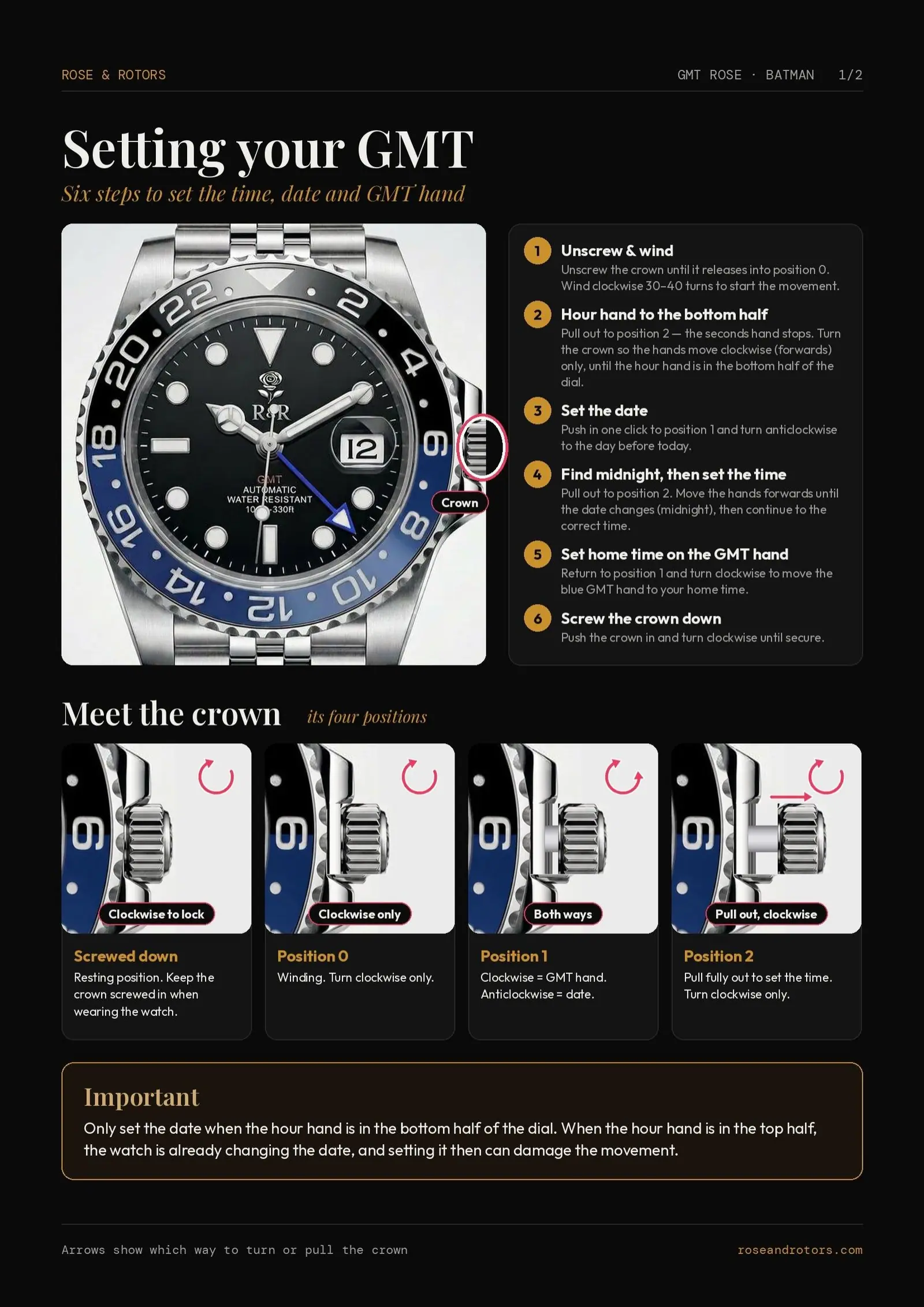
The exact process varies slightly between movements, but the NH34 follows a simple procedure.
Step 1: Set Local Time
Pull the crown to the time-setting position.
Adjust the hour and minute hands until the correct local time is displayed.
Step 2: Set the GMT Hand
Move the crown to the GMT-setting position.
Adjust the GMT hand to your chosen second time zone.
For example, with local time set to London 12:00, set the GMT hand to New York 07:00. The watch now tracks both locations simultaneously.
Step 3: Set the Date
Adjust the date if required. Your GMT watch is now ready to use.
Can a GMT Watch Track Three Time Zones?
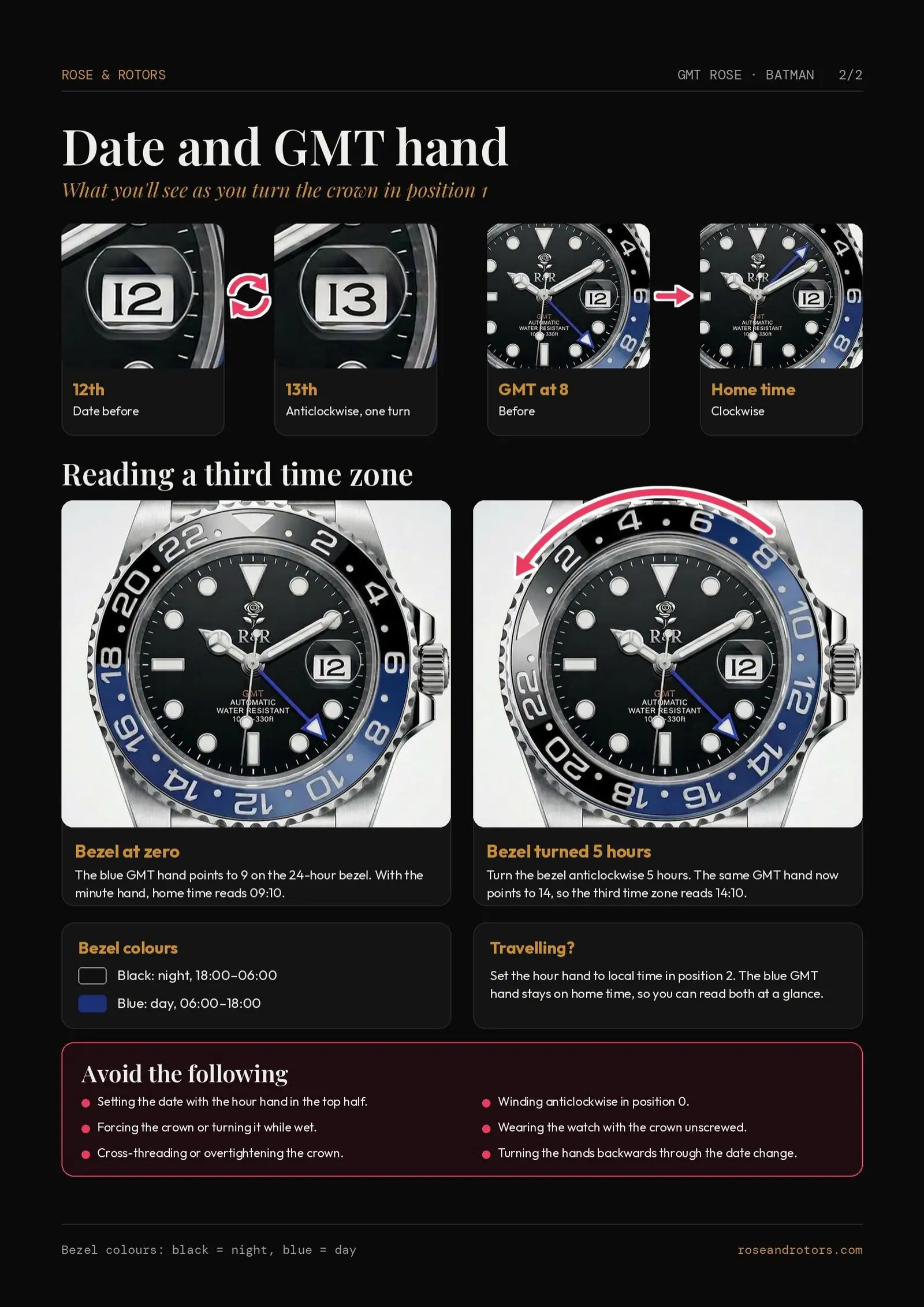
Yes. If your watch uses a rotating 24-hour bezel, you can track a third time zone.
For example: main hands set to London, GMT hand set to New York, and rotated bezel aligned to Tokyo.
This feature is one reason GMT watches remain so popular among frequent travellers.
Who Should Buy a GMT Watch?
GMT watches are ideal for:
Frequent Travellers
Track local time and home time simultaneously.
Remote Workers
Keep track of colleagues in different countries.
International Business Owners
Monitor overseas clients and suppliers.
Watch Enthusiasts
Enjoy one of watchmaking's most practical complications.
Why GMT Watches Are So Popular
GMT watches combine practicality with distinctive styling.
Many enthusiasts appreciate:
- The extra GMT hand
- Two-tone 24-hour bezels
- Travel functionality
- Rich aviation heritage
They offer genuine everyday usefulness while adding visual character to the watch.
The Rose & Rotors Approach
At Rose & Rotors, our GMT watches are powered by the proven Seiko NH34 movement.
The NH34 combines:
- Reliable automatic winding
- GMT functionality
- Manual winding capability
- Hacking seconds
- Excellent durability
The result is a dependable travel companion capable of tracking multiple time zones with ease.
Frequently Asked Questions
What does GMT stand for?
GMT stands for Greenwich Mean Time, historically used as the world's reference time standard.
What is the fourth hand on a GMT watch?
The fourth hand is the GMT hand. It completes one rotation every 24 hours and tracks a second time zone.
Is the NH34 a good GMT movement?
Yes. The NH34 is widely regarded as one of the best-value automatic GMT movements available today.
What is the difference between a Flyer GMT and an Office GMT?
A Flyer GMT allows the local hour hand to be adjusted independently. An Office GMT allows the GMT hand to be adjusted independently.
Can a GMT watch track three time zones?
Yes. Watches with rotating 24-hour bezels can often track a third time zone.
Do I need to travel to enjoy a GMT watch?
Not at all. Many enthusiasts enjoy GMT watches simply because they are practical, attractive and historically significant.
Explore GMT Watches from Rose & Rotors
Whether you're a frequent traveller, an international business professional or simply a watch enthusiast, a GMT watch is one of the most useful complications you can own.
Explore the Rose & Rotors GMT collection and discover watches powered by the reliable Seiko NH34 movement, designed to keep you connected across multiple time zones.
Keep exploring
Related watches
Related collections
Frequently Asked Questions
What is the difference between a caller GMT and a flyer GMT?
On a caller GMT (like the NH34) you adjust the 24-hour hand on its own. On a flyer GMT the local hour hand jumps on its own. Both show two time zones; the true GMT is just quicker to change when you travel.
Can a GMT watch show three time zones?
Yes. Turning the 24-hour bezel lets the GMT hand read a third zone.
Which Rose & Rotors watch is a GMT?
The GMT Rose, powered by the Seiko NH34.