Guide
How to Use a GMT Watch
A practical guide to setting the GMT hand, reading the 24-hour scale and using a rotating bezel to track a second — or third — time zone.
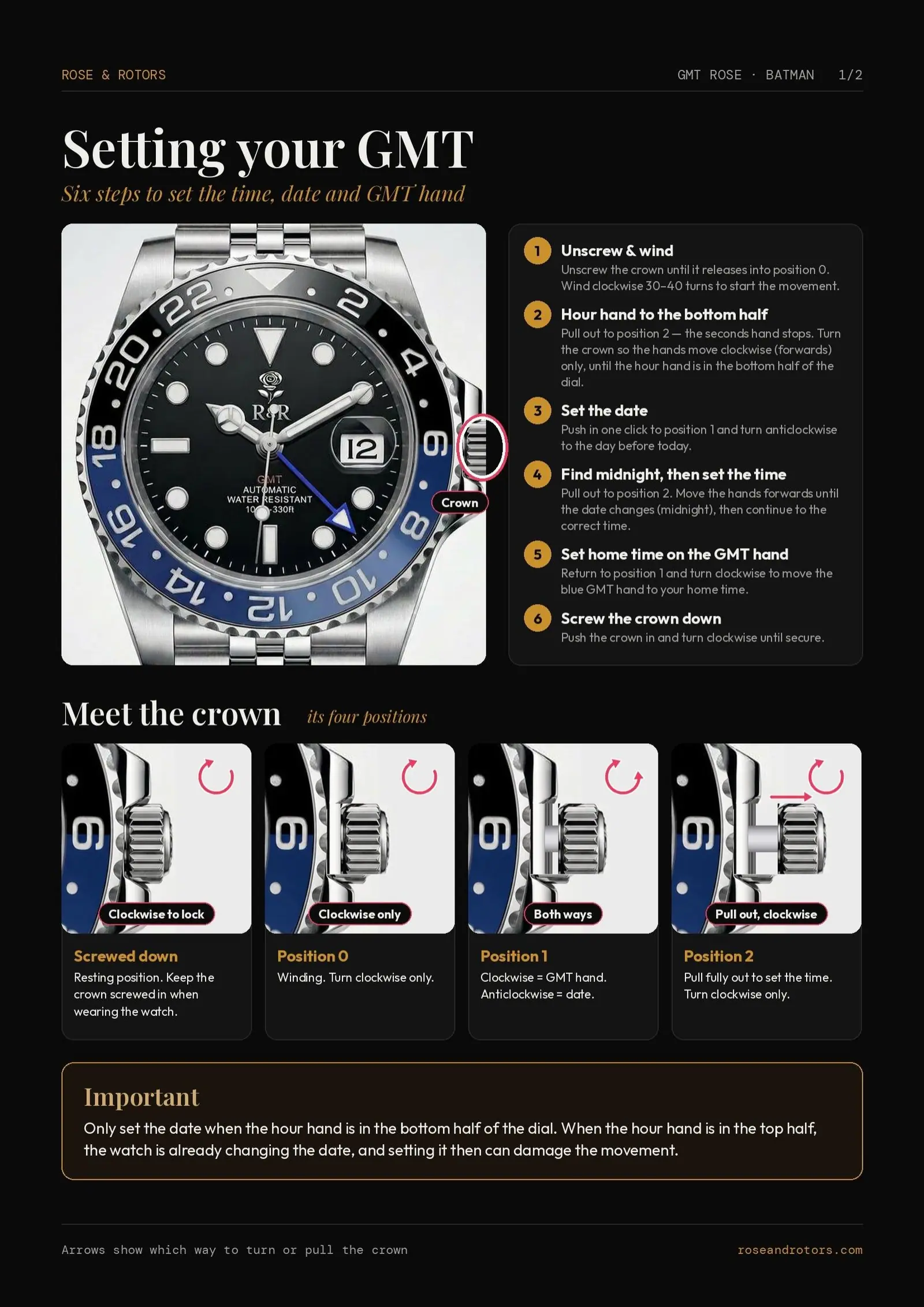
Quick answer: To use a GMT watch, set local time with the main hands, then set the 24-hour hand to your home time zone and read it on the 24-hour bezel. On the GMT Rose (Seiko NH34) pull the crown to position 1 and turn clockwise to move the GMT hand.
Shop GMT Watches →How to set and use it
What the GMT Hand Actually Does
A GMT watch adds a fourth central hand that completes one full rotation every 24 hours instead of every 12. Read against a 24-hour scale — printed on the bezel, the rehaut or the dial — it tells you the time in a second zone at a glance.
Because the scale runs to 24, there is no ambiguity between morning and evening in the second zone: 07 is breakfast, 19 is dinner.
Setting a GMT Watch: Step by Step
- Unscrew the crown (if screw-down) and pull it to the first click.
- Set the 24-hour GMT hand to your home time using the 24-hour scale.
- Pull the crown to the second click and set the main hour and minute hands to your local time.
- Push the crown fully home and screw it down to restore water resistance.
- Check the date rolls over at midnight local time, not midday — if it flips at noon, advance the hour hand 12 hours.
On a caller-style GMT such as the Seiko NH34, the GMT hand is the one that jumps independently, so set your local time first and then move the GMT hand to your home zone. Our guide to the movement explains the difference:
Seiko NH34 GMT Movement Explained →
Using the GMT Bezel for a Third Time Zone
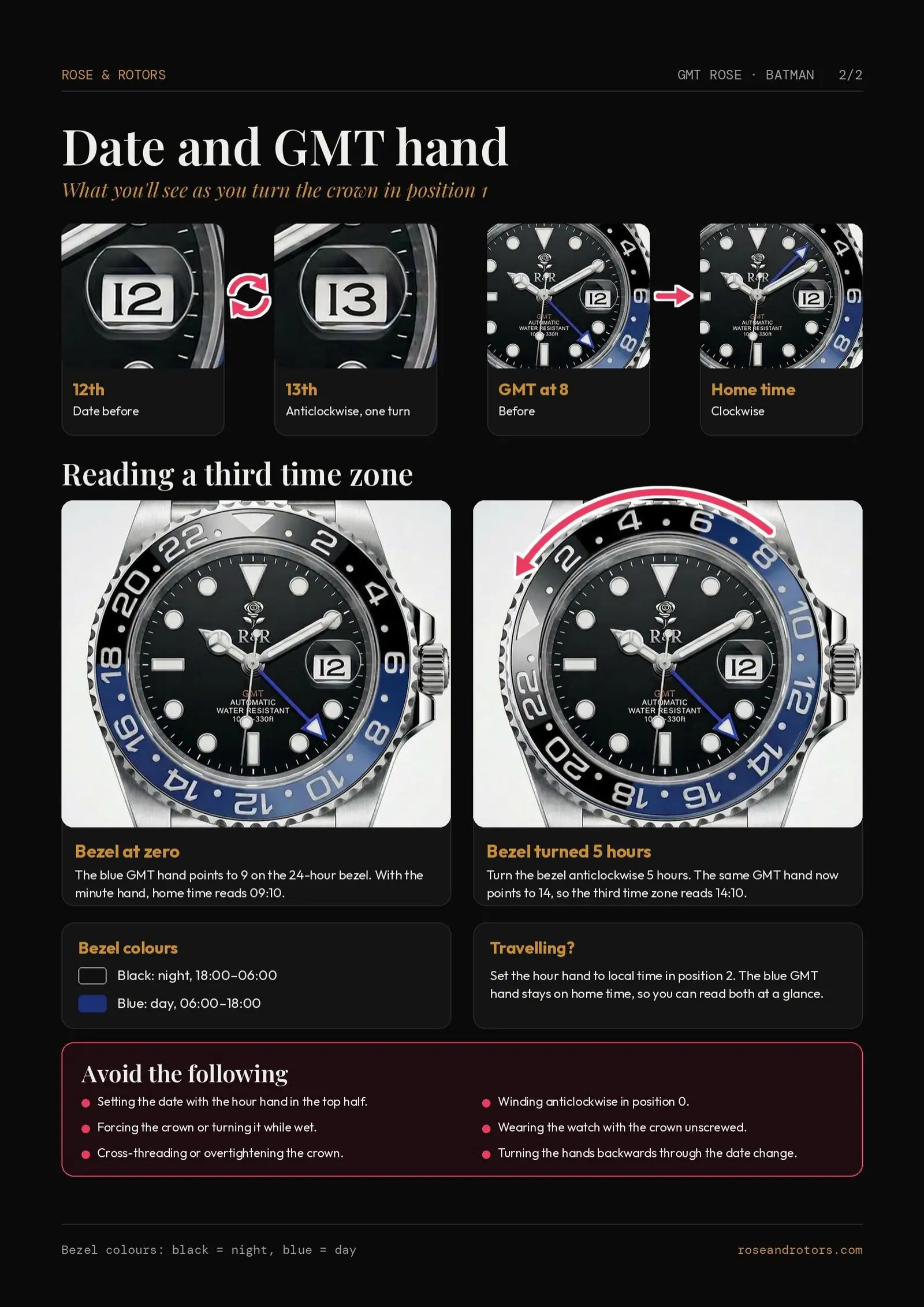
If your watch has a bidirectional rotating 24-hour bezel, you can track a third zone without touching the crown. Rotate the bezel forwards or backwards by the number of hours the third zone differs from the time shown by the GMT hand, then read the GMT hand against the bezel.
Rotate anticlockwise to add hours (east), clockwise to subtract (west). Return the bezel to 24 at the top when you are finished so the GMT hand reads your home time again.
Caller GMT vs Traveller GMT
A caller GMT (also called an office GMT) lets you jump the 24-hour hand independently — ideal if you stay in one place and keep in touch with people abroad. A traveller GMT jumps the local hour hand instead, which suits frequent flyers changing zones on arrival.
Rose & Rotors GMT models use the Seiko NH34, a caller-style GMT. It is honest, reliable and serviceable — see how it compares to the standard three-hand NH35:
NH34 vs NH35: Which Movement Is Right for You? →
Everyday Tips
- Set the GMT hand to UTC if you want a universal reference for travel or aviation.
- Avoid changing the date between 9pm and 3am while the date mechanism is engaged.
- Wear the watch daily, or use a winder, to keep the movement running within spec.
- Check bezel alignment before buying — a well-aligned 24-hour bezel is a sign of careful assembly.
Ready to try one on the wrist? Explore our GMT models, all hand-assembled in the UK around the Seiko NH34.
Keep exploring
Related watches
Related collections
Frequently Asked Questions
How do you use a GMT watch?
Set the 24-hour GMT hand to your home time and the main hands to your local time. Read the GMT hand against the 24-hour scale to see your home zone, and rotate the 24-hour bezel to track a third zone.
How do you set the GMT hand?
Pull the crown to the first click to adjust the 24-hour GMT hand independently, then pull to the second click to set the local hour and minute hands. Push the crown home and screw it down afterwards.
What is the difference between a caller GMT and a traveller GMT?
A caller GMT jumps the 24-hour hand independently, which suits people who call abroad from home. A traveller GMT jumps the local hour hand, which suits frequent travellers. The Seiko NH34 used in Rose & Rotors GMT models is a caller GMT.
How do you use a GMT bezel?
Rotate the 24-hour bezel by the hour difference of the third time zone — anticlockwise to add hours, clockwise to subtract — then read the GMT hand against the bezel scale.